The Form That Can Make — or Break —
Your Nevada Sale
One document decides who's legally on the hook after closing. Here's what Nevada's Seller's Real Property Disclosure actually requires, what "as-is" really means, and the HOA paperwork that trips up more Las Vegas deals than anything else.
Every Nevada home sale runs through a short form most people skim and sign. That's a mistake. The Seller's Real Property Disclosure shapes what a seller owes a buyer, what a buyer can do if something was hidden, and how much liability follows the deal after the keys change hands. Here's what it actually says — in plain English.
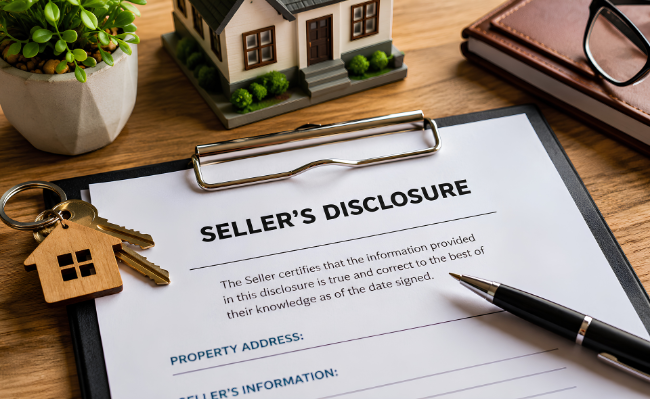
Paperwork that protects both sides. Nevada's disclosure law is built to keep the transaction honest — for buyer and seller alike.
Four Numbers From the Statute
What the Disclosure Form Actually Covers
Under NRS 113.130, almost every seller of residential property in Nevada must complete and hand the buyer a Seller's Real Property Disclosure (SRPD) — Nevada Real Estate Division Form 547. It covers the condition of the electrical, plumbing, heating and cooling systems, the roof and structure, and anything else known to the seller that materially affects the property's value or use. The form must come from the seller directly; a seller's agent is not allowed to fill it out on the seller's behalf.
Critically, the duty only runs to what the seller actually knows. NRS 113.140 is explicit: a seller does not have to disclose a defect they're unaware of, and the completed form is not a warranty. Buyers still carry a duty to use reasonable care — which is exactly why a professional inspection matters, disclosure form or not.
These disclosures cover electrical, heating, cooling, plumbing and sewer systems, and anything else on the property that affects use or value.— Nevada Revised Statutes § 113.120
Who's Actually Required to Disclose
Nearly Every Sale
If you're an ordinary seller of residential property to an unrelated buyer, the SRPD is mandatory. A buyer can never be forced to waive the right to receive it.
Five Specific Situations
- Foreclosure sales
- Sales between co-owners, spouses, or close relatives
- The first sale of new construction by a licensed contractor
- Certain relocation / temporary title transfers
- Certain fiduciary transfers (estates, trusts, guardianships)

“As-is” has limits. Selling as-is waives repairs — not the legal duty to disclose what you know.
"As-Is" Doesn't Mean What Most People Think
This is where sellers get into trouble. Listing a home "as-is" tells the buyer you won't make repairs — it does not excuse you from disclosing known defects. Sellers can and often do sign the SRPD alongside a separate as-is addendum; the two documents do different jobs. Skip the disclosure and hide something you knew about, and "as-is" offers no protection at all.
What the Buyer Can Actually Do
Rescind, No Penalty
If the seller never serves a completed SRPD as required, the buyer may rescind the purchase agreement at any time before conveyance — walking away clean, with no penalty.
Treble Damages
If a seller knew about a defect and didn't disclose it, the buyer can recover three times the repair cost, plus court costs and attorney's fees — a $10,000 problem can become a $30,000-plus judgment.
The claim window runs one year from when the buyer discovers (or should have discovered) the defect, or two years from the sale — whichever is later. That's a long tail of liability for something that would have cost far less to simply disclose upfront.
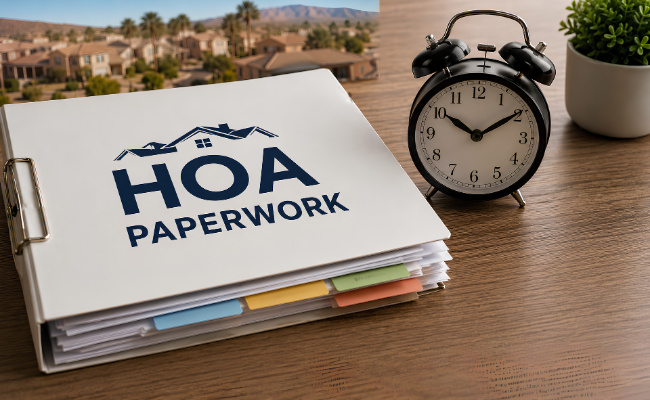
HOA paperwork, on the clock. In master-planned Las Vegas, the resale package is often the deal's tightest deadline.
Buying in an HOA? There's a Second Form
Summerlin, Henderson, and most master-planned Las Vegas Valley communities are common-interest communities (CICs) under NRS Chapter 116 — a separate law from the SRPD. When you buy a resale home in an HOA, the seller must also provide a resale package: CC&Rs, bylaws, current financials, the reserve study, and any pending litigation or special assessments.
The Most Common Closing Delay
Because the resale package can take days to weeks to arrive, it's one of the most frequent causes of a delayed closing in HOA-heavy markets like Summerlin and Henderson. Order it early, read it closely — assessments, litigation, and rule changes live in that package, not the SRPD.
Buyers & Sellers, Take Note
◆ If You're Buying
- Read the SRPD line by line — it's the seller's own words about what's wrong with the home, not marketing copy.
- Never skip the inspection. The form only covers what the seller knows; it's not a substitute for due diligence.
- Know your HOA clock. If you're in a CIC, the 5-day cancellation window starts the moment the resale package arrives — don't let it lapse unread.
◆ If You're Selling
- Disclose everything you know — even if you're selling as-is. The math on concealment (treble damages) rarely favors staying quiet.
- Order the HOA resale package early. It's the single most common cause of closing delays in master-planned communities.
- Update the form if things change. A new defect discovered before closing must be disclosed in writing, even after the SRPD is signed.
Buying or Selling in Nevada?
Disclosure law, HOA paperwork, deadlines — Legacy Real Estate Group walks every client through it, so nothing gets missed before closing.
Sources: Nevada Revised Statutes 113.100–113.150 (Seller's Real Property Disclosure); Nevada Revised Statutes 116.4109 & 116.41095 (common-interest community resale package); Nevada Real Estate Division Form 547. Rules current as of 2026 and subject to change; individual transactions vary — confirm details with your agent or an attorney.
This article is for general educational purposes only and is not legal advice. Consult a licensed Nevada attorney or your real estate agent about your specific transaction. Legacy Real Estate Group is committed to the letter and spirit of U.S. policy for equal housing opportunity.