What the 2026 Forecast Says About Las Vegas Growth
Clark County is still projected to grow, but at a slower long-term pace. Here is what the population forecast, employment outlook, and July resale data actually show.
Clark County is still expected to add residents and jobs, but UNLV's 2026 long-range forecast places that growth on a slower path than the previous forecast. CBER projects about 204,000 additional residents and 117,000 additional jobs from 2026 through 2036. Separately, July Southern Nevada resale data showed a $480,000 median price for existing single-family homes and nearly four months of reported housing supply.
Read the Geography Correctly
Clark County: The population and employment figures are long-range CBER projections for the county.
Southern Nevada resale market: The price, listing, sales, and supply figures describe existing properties reported through the Las Vegas Realtors MLS during July 2026.
Important distinction: A long-range population forecast is not a short-term home-price forecast, and one month of resale data does not describe every property transaction or new-construction sale.

A More Precise Growth Story. Southern Nevada’s growth story comes into sharper focus when long-range Clark County forecasts are viewed alongside monthly resale trends. Together, these data sets provide a clearer foundation for smarter real estate decisions.
Five Numbers Behind the Story
Is Clark County Still Growing?
Yes. The 2026 CBER forecast still projects population growth in Clark County. The change is the projected pace and timing of that growth. CBER now expects the county to reach 3 million residents in 2055, about a decade later than the prior forecast's 2045 milestone.
For the 2026-to-2036 period, CBER projects approximately 204,000 additional residents. The comparable period in the previous forecast showed approximately 347,000 additional residents. That is a revision to the forecast's growth path; it is not a projection that Clark County will lose population.
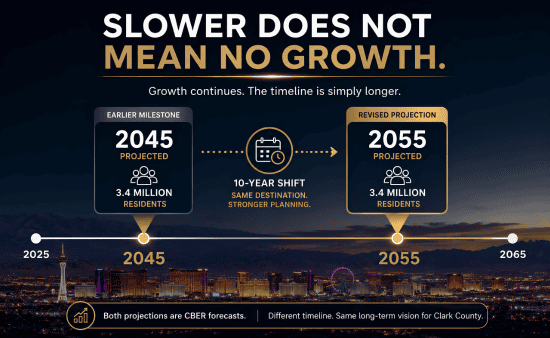
Slower Does Not Mean No Growth. Slower projected growth does not mean Southern Nevada is standing still—it means the timeline is changing. By separating employment trends from Clark County’s population outlook, we can better understand how jobs and residents may grow along different paths while still shaping the region’s long-term future.
The revised forecast changes the pace and timing of projected growth; it does not eliminate projected growth.Data distinction from CBER's 2026 Clark County Forecast
A Planning Tool, Not a Price Prediction
What CBER Measures
CBER's long-range forecast estimates future population and employment levels for Clark County. The 2026 report projects approximately 2.77 million residents by 2040, more than 3 million in 2055, and approximately 3.08 million by 2060.
How Agencies Use It
UNLV reports that regional agencies use the forecast for long-range planning involving water resources, transportation, and public services. That planning role does not guarantee a particular project, service level, or future development outcome.
Jobs Are a Separate Measure of Growth
CBER projects approximately 117,000 additional Clark County jobs between 2026 and 2036. The sectors expected to show the largest gains are accommodation and food services, health care and social assistance, and transportation and warehousing.
Separately, the Las Vegas Global Economic Alliance announced four new or expanding Southern Nevada business operations expected to create more than 430 jobs, generate more than $55 million in capital investment, and deliver more than $322 million in economic impact over the following two years. The announcement describes those figures as expected outcomes, not completed results.[3]
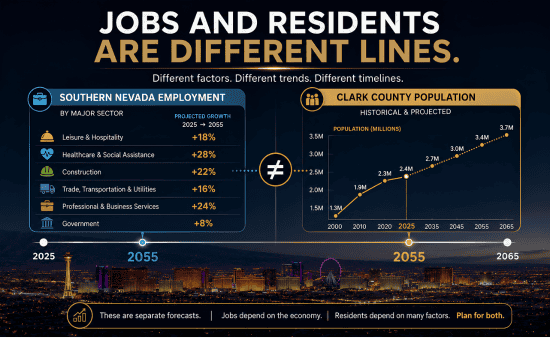
Jobs and Residents Are Different Lines. Employment growth and population growth are connected, but they are not the same forecast. Southern Nevada’s job trends reflect economic activity across major sectors, while Clark County’s population outlook depends on broader factors such as migration, housing demand, and household formation—making it important to plan for both separately.
What Did Southern Nevada Housing Data Show?
According to Las Vegas Realtors data reported by the Las Vegas Review-Journal, the median price of existing single-family homes sold through the LVR MLS in Southern Nevada during July 2026 was $480,000. That was 1% below July 2025 and 2% below the record high set in May and June.
The July median for local condos and townhomes was $290,000, unchanged from July 2025. LVR reported 7,442 single-family homes listed without an offer, up 4.1% from a year earlier, and 2,719 condos and townhomes listed without offers, up 3.7% year over year.
LVR reported 2,587 existing local homes, condos, and townhomes sold in July. The reported sales pace equated to nearly four months of housing supply, similar to one year earlier. LVR's figures are based on its MLS and do not include all newly constructed homes sold by builders or all homes sold directly by owners.
Single-Family Homes
Median: $480,000 in July 2026.
Year over year: Down 1%.
From record: Down 2% from the May-June high.
Listed without offers: 7,442.
Condos & Townhomes
Median: $290,000 in July 2026.
Year over year: Unchanged.
Listed without offers: 2,719.
Reported supply: Included in the nearly four-month total.
What This Data Does Not Prove
It does not predict future home prices.
CBER's forecast is a long-range population and employment planning tool. The July price and supply figures are one month of reported resale-market activity. Neither source, by itself, establishes that prices will rise or fall.
It does not prove that projected jobs will be filled by local residents.
The 117,000-job figure is a CBER projection, and the more-than-430-job figure is an LVGEA announcement describing expected outcomes. The data does not identify who will fill each position or where those workers will live.
It does not identify which neighborhoods will outperform.
The sources reviewed here report county-level forecasts and Southern Nevada resale statistics. They do not establish future performance for a specific Las Vegas, Henderson, Summerlin, or North Las Vegas neighborhood.
Las Vegas Housing Growth FAQ
Is Clark County still growing?
Yes. CBER's revised 2026 forecast still projects population growth, including approximately 204,000 additional residents between 2026 and 2036, but at a slower pace than the previous forecast.
When does the revised forecast project 3 million Clark County residents?
The 2026 CBER forecast projects that Clark County will reach 3 million residents in 2055.
What was the July 2026 median price for an existing Southern Nevada single-family home?
The reported median was $480,000 for existing single-family homes sold through the LVR MLS in Southern Nevada.
How much housing supply was reported in July?
The July sales pace equated to nearly four months of housing supply, similar to one year earlier.
Does the population forecast predict Las Vegas home prices?
No. CBER's forecast is designed for long-range planning, while the July price and supply figures describe monthly resale-market activity. They answer different questions.
Talk With a Legacy Agent
For current property-specific information in Las Vegas and Southern Nevada, connect with the Legacy Real Estate Group team.
Talk With a Legacy Agent8345 W Sunset Road, Suite 320 · Las Vegas, NV 89113 · 702-786-9457 · [email protected]
Sources
- UNLV News Center, “CBER Population Forecast: Clark County's Path to 3 Million Slows by a Decade,” July 22, 2026.
- Las Vegas Review-Journal, “LVR reports local home prices pull back from record high,” August 14, 2026.
- Las Vegas Global Economic Alliance, “Southern Nevada Secures More Than 430 New Jobs and $55 Million in Capital Investment Through Business Expansions and New Operations,” August 5, 2026.