Las Vegas Water Policy Is Now a Due-Diligence Question
The finalized 2027–2028 Colorado River guidelines, Nevada’s lawsuit, and the property-level water questions buyers and sellers should verify.
The U.S. Department of the Interior finalized Colorado River operating decisions on August 21, including a 1.25 million acre-foot reduction in Lower Basin deliveries for calendar year 2027. Nevada’s near-term share is described as 50,000 acre-feet per year for 2027 and 2028 under the Lower Basin sharing arrangement, while Nevada, the Colorado River Commission of Nevada, and the Southern Nevada Water Authority filed suit on August 24.
What Is Actually Confirmed?
Federal action: Interior issued the 2027–2028 Operating Guidelines and a Record of Decision for a 10-year Colorado River Decision Framework.
Near-term reduction: The federal release says Lower Basin deliveries from Lake Mead will be reduced by 1.25 million acre-feet for calendar year 2027. The Nevada Independent reports a 50,000-acre-foot annual Nevada share for 2027 and 2028 under the near-term arrangement.
Litigation: Nevada and two state water entities filed suit alleging violations of the Law of the River, the Administrative Procedure Act, and the National Environmental Policy Act. Those are allegations in a pending case, not final court findings.
Existing infrastructure: SNWA says Intake No. 3 began conveying water to treatment facilities in September 2015 and was built to draw Colorado River water at Lake Mead elevations below 1,000 feet.
Not established: The sources do not establish that the policy will raise or lower home values, stop all development, or create a specific outcome for an individual property.
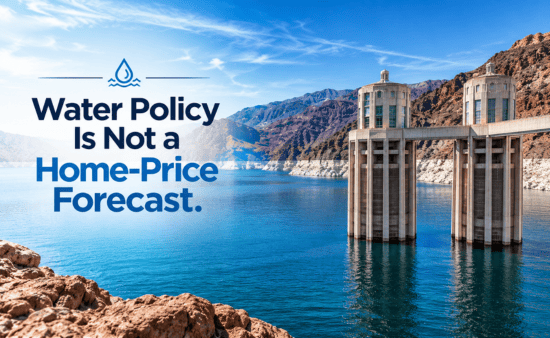
Water Policy Is Not a Home-Price Forecast. Lake Mead's water levels reflect regional supply management—not a signal for any specific neighborhood's home values.
Five Numbers and Dates to Know
Why This Belongs in Housing Due Diligence
The confirmed real-estate relevance is a diligence issue, not a price prediction. Water policy governs a regional resource and its operating rules. A purchase contract, however, concerns a specific parcel, its service provider, its meter, its utility account, its landscaping, and its governing documents. The federal release and the lawsuit do not answer those property-level questions.
Southern Nevada’s water system also has more than one layer. SNWA describes itself as a regional water agency that treats and delivers wholesale water to municipal providers, while its charges page states that SNWA is not a water-service provider. The buyer should identify the retail provider for the address and request current, property-specific information from that provider.
For a home in the Las Vegas Valley Water District service area, the current published rules include a four-tier residential rate structure, service charges based on meter size, and additional conservation-related charges. These are published utility rules and rates, not a universal estimate of a particular home’s bill.
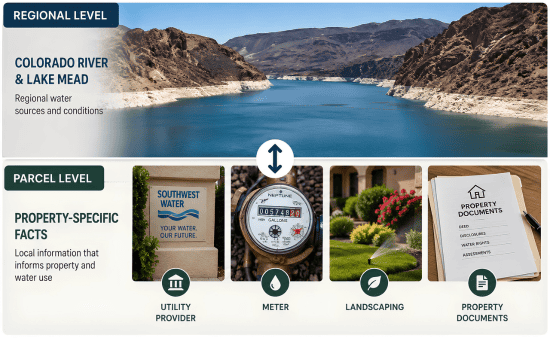
Separate Regional Policy From Parcel Facts. Regional water conditions and parcel-specific facts are two different layers—don't let one substitute for the other.
A finalized regional operating decision and a pending lawsuit are not the same thing as a property-level service determination.Facts-first distinction for buyers, sellers, and housing professionals
What Should Be Verified About a Property?
Questions for the Water Provider
- Retail provider: Confirm which municipal water provider serves the property address. SNWA says it is not the retail water-service provider.
- Service status: Confirm whether the property has an active meter and service account, and ask the provider about any property-specific balance, deposit, connection, or activation requirement.
- Current charges: Request the current rate schedule and review recent bills rather than estimating from a regional headline. LVVWD publishes meter-based service charges and usage tiers.
- Watering rules: Verify the watering group, seasonal schedule, and any water-waste or excessive-use charges that apply to the address.
Questions About the Property
- Landscape date: In the LVVWD service area, grass and spray irrigation are prohibited in new development occurring since April 5, 2022, subject to the published exceptions.
- Pool and water features: New single-family residential pools and spas in the LVVWD service area are limited to 600 square feet of surface area; local ordinances also regulate water features. Verify the rule for the property’s jurisdiction and construction date.
- HOA documents: Review association rules, landscape obligations, common-area charges, and any restrictions that affect outdoor water use.
- New construction: Obtain written, property-specific confirmation of water service, connection status, and applicable utility requirements from the developer and serving provider.
The Region Has Both Conservation Rules and Infrastructure
LVVWD states that the Las Vegas Valley gets about 90 percent of its water from the Colorado River and that Lake Mead is the source of most of the community’s drinking water. The district also reports that conservation efforts reduced per-capita water use by 58 percent between 2002 and 2025 while the population increased by approximately 876,000 residents.
SNWA’s Intake No. 3 is an existing physical backstop. SNWA says the intake was constructed to draw Colorado River water at lake elevations below 1,000 feet, began conveying water in September 2015, and protects access to Southern Nevada’s primary water supply if lake levels continue to decline. That infrastructure fact does not resolve the separate legal and policy dispute over future allocations.
Current rules also affect how properties are used. LVVWD publishes restrictions involving watering schedules, grass and spray irrigation, pool size, water features, golf courses, and excessive-use charges. The applicable rule depends on the property’s location, type, construction date, utility provider, and governing documents.
What the Water News Does Not Establish
It does not establish that Las Vegas homes will become more or less valuable.
The sources establish federal operating decisions, regional water conditions, infrastructure, conservation rules, and litigation. They do not provide a study connecting the August 2026 water actions to a specific movement in residential property values.
It does not establish that a 213,556-acre-foot shortfall will occur.
News 3 reports that Nevada’s complaint alleges the federal guidelines could lead to a shortfall of 213,556 acre-feet. The figure is a litigation allegation and potential exposure described in reporting, not a final court finding or a statement that the shortfall is currently being delivered.
It does not establish that Intake No. 3 removes all water risk.
SNWA describes Intake No. 3 as infrastructure designed to maintain access to Lake Mead water at lower lake elevations. It does not describe the intake as unlimited supply, a guarantee against future restrictions, or a resolution of Colorado River allocation disputes.
It does not establish that every property has the same water rules or costs.
Water providers, cities, counties, HOAs, property types, construction dates, meters, and existing improvements can affect the applicable requirements. A property-specific review is necessary.
Las Vegas Water Policy & Housing FAQ
What did Interior finalize on August 21, 2026?
Interior issued the 2027–2028 Operating Guidelines and the Record of Decision for the Post-2026 Colorado River Operations Final Environmental Impact Statement. The decisions establish a 10-year Decision Framework and include a 1.25 million acre-foot reduction in Lower Basin deliveries from Lake Mead for calendar year 2027.
What does the 50,000-acre-foot figure mean?
The Nevada Independent reports that Nevada will give up 50,000 acre-feet of Colorado River water per year over the next two years under the near-term operating framework. It is a policy and allocation figure; it is not a statement that every property will lose service or that a specific home will experience a particular interruption.
What did Nevada file on August 24?
Nevada, the Colorado River Commission of Nevada, and the Southern Nevada Water Authority filed suit alleging that the Interior framework violates the Law of the River, the Administrative Procedure Act, and the National Environmental Policy Act. Nevada asks the court to vacate the 2027–2036 framework. The case was pending as of the reporting date.
Who should a buyer contact about water service?
The buyer should identify the retail water provider serving the address and contact that provider for account, meter, connection, rate, watering, and property-specific questions. SNWA’s published charges page states that SNWA is not a water-service provider.
What is the most defensible real-estate takeaway?
Water policy is a reason to perform careful, property-specific due diligence. It is not, by itself, evidence that a property will gain or lose value, that development will stop, or that a buyer or seller will benefit from waiting.
Talk With a Legacy Agent
For current property-specific information in Las Vegas and Southern Nevada, connect with the Legacy Real Estate Group team.
Talk With a Legacy Agent8345 W Sunset Road, Suite 320 · Las Vegas, NV 89113 · 702-786-9457 · [email protected]
Sources
- U.S. Department of the Interior, “Interior Department Finalizes Plans for 2027-2028 Colorado River Operations,” August 21, 2026.
- News 3 Las Vegas, “Nevada sues federal government over Colorado River water cuts,” August 24, 2026.
- The Nevada Independent, “Nevada to lose a third of its Colorado River water over the next two years. What happens next?” July 30, 2026.
- The Nevada Independent, “Nevada sues Interior over cuts to ‘already meager’ Colorado River water allocation,” August 24, 2026.
- Southern Nevada Water Authority, “Intake No. 3.”
- Las Vegas Valley Water District, “Drought and conservation measures.”
- Las Vegas Valley Water District, “Rates, fees and charges.”
- Southern Nevada Water Authority, “Water Authority charges.”