Nevada's Innovation Economy: Research, Startups and Career Opportunities
- By Tara Huntington
- Posted
Nevada’s Research Economy Is Building New Career and Business Connections
A new state report details measurable economic impacts from university research, a growing startup pipeline, and current labor-market conditions in Reno and Las Vegas.
Nevada’s economy includes more than tourism, hospitality, and entertainment. The Nevada Governor’s Office of Economic Development’s 2026 Knowledge Fund annual report describes research and commercialization activity involving the University of Nevada, Reno, UNLV, the Desert Research Institute, private companies, and startup programs. The report also presents modeled economic impacts tied to selected research investments.
What the New Report Shows
Research institutions: The report covers Knowledge Fund investments connected to UNR, UNLV, and DRI.
Economic modeling: The report associated selected investments with employment, labor-income, value-added, and output estimates.
Startup participation: ZeroLabs reported 145 companies across nine cohorts, with nearly $12.2 million raised after Launchpad.
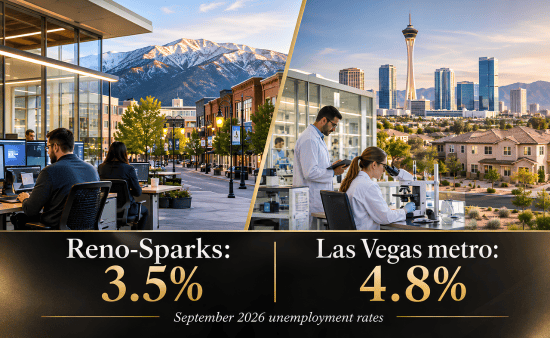
Workforce context: September 2026 unemployment rates were 3.5% in the Reno-Sparks MSA and 4.8% in the Las Vegas MSA.
Important limit: Modeled economic impacts and startup funding are not guarantees of future jobs, business success, or real-estate appreciation.
Five Facts Beyond the Strip

Nevada’s Innovation Base Includes Universities, Labs, and Private Companies
The Knowledge Fund report describes a network involving UNR, UNLV, DRI, business leaders, private industry, venture capital, government agencies, incubators, and accelerators. The stated purpose is to move research toward commercial applications and support collaboration between academic and business participants.
For people considering Nevada, this is a useful fact about the state’s economic structure: research and technology programs operate alongside the industries for which Nevada is better known. The report identifies activity in areas that include research commercialization, water technology, safety systems, quantum-related technology, and other innovation programs.
This does not mean every program is a large employer or that every startup will continue operating. It does show that Nevada has organized programs intended to connect research, capital, entrepreneurship, and private-sector activity.
Nevada’s economic story includes a growing connection between research institutions and companies developing products, services, and technologies.A positive fact, without a forecast
A State Report Modeled 6,798 Employment Impacts
The largest modeled result described in the report involved a $393.0 million investment connected to UNR and NCAR-related research. Using the IMPLAN economic model, the report estimated 6,798 total employment impacts, $556.3 million in labor income, $831.8 million in value-added impacts, and $1.3689 billion in value of output.
The report separates the estimate into direct, indirect, and induced effects. It defines labor income as employee compensation plus proprietor income. Value of output is a measure of production in the modeled economy, not a count of money paid to one group of workers.
These are economic-impact estimates associated with the study’s inputs and assumptions. They are not a claim that 6,798 permanent jobs were newly created or that each position is currently open.
Other Research Investments Produced Separate Modeled Results
UNLV Research Investment
- Investment: $34.8 million, as reported.
- Employment impact: 535 total modeled employment impacts.
- Labor income: $42.5 million in the model.
- Value of output: $94.7 million in the model.
DRI Research Investment
- Investment: $61.9 million, as reported.
- Employment impact: 1,076 total modeled employment impacts.
- Employee compensation: $81.9 million in the model.
- Value of output: $165.1 million in the model.
ZeroLabs Reports 145 Companies Across Nine Cohorts
The report says 145 companies across nine ZeroLabs cohorts participated in the program and raised nearly $12.2 million after Launchpad. It also reports that 34 companies had raised funding rounds after completing the program.
Participating companies had approximately 94 employees in Nevada at the time described in the report. The report says 70% of respondents to the latest ZeroLabs alumni survey planned to raise funding within the following six months.
Startup participation and fundraising are indicators of entrepreneurial activity. They do not establish that every company will receive additional capital, expand its workforce, or remain in Nevada.

Water Technology and Quantum-Related Companies Are Part of the Mix
The report identifies several companies connected to the state’s entrepreneurship and commercialization programs. WAVR attracted additional research-and-development grant support from WaterStart and received $1.5 million in seed-round capital from Las Vegas-based Desert Forge Ventures, along with an equal match from Battle Born Growth, according to the report.
The report also says Quantum Copper continued technology development at UNLV labs and is building the company in Las Vegas. It reports that Quantum Copper had raised $9.45 million since its first seed-capital round in 2010.
These examples are interesting because they show Nevada-based activity in water technology and advanced materials rather than only visitor-facing industries. They are individual company facts, not a guarantee about the broader startup market.
Reno and Las Vegas Reported Lower Unemployment Than a Year Earlier
Nevada’s workforce agency reported that the Reno-Sparks metropolitan area had a 3.5% unemployment rate in September 2026, unchanged from August and down 0.8 percentage points from September 2025. The Reno-Sparks labor force totaled 301,707 people, and the number of employed individuals was 291,000.
The Las Vegas-Henderson-North Las Vegas metropolitan area had a 4.8% unemployment rate in September 2026, unchanged from August and down 0.9 percentage points from September 2025.
Unemployment rates describe labor-market conditions, not the experience of every worker. Job availability varies by occupation, experience, pay, location, and employer.
Relocation Decisions Include More Than Home Prices
People considering a move often compare housing costs, employment opportunities, schools, healthcare, taxes, transportation, climate, and community amenities. The Knowledge Fund report adds a positive economic-development fact to that broader review: Nevada has active programs connecting universities, research institutions, entrepreneurs, investors, and private companies.
The workforce data add current labor-market context in the state’s two largest metropolitan areas. They do not answer whether a particular newcomer will find a job, but they provide a factual snapshot of September conditions.
Housing remains a separate due-diligence question. A prospective resident should compare a specific job offer, commute, housing payment, insurance, utilities, taxes, schools, and available services before deciding where to live.
Economic Activity Is Relevant Context, Not a Property Forecast
For Buyers
- Employment research: Review industries and employers relevant to your occupation.
- Location research: Compare a potential home with job locations, commute times, and services.
- Affordability: Calculate housing and ownership costs using your own income and financing terms.
- Verification: Treat modeled impacts as context, not as a promise of a specific job.
For Sellers
- Accurate context: Nevada’s innovation programs can be described as part of the state economy.
- No guarantees: Do not claim research activity guarantees appreciation or buyer demand.
- Specific evidence: Use current comparable sales and local market data for pricing.
- Local diligence: A statewide report does not establish conditions around one property.
What the Report Does Not Establish
Keep These Distinctions Clear
Modeled impact is not a guarantee: The GOED figures are estimates based on an economic model.
Funding is not profitability: Startup capital does not prove future revenue or long-term survival.
Unemployment is not a job offer: A metro rate does not determine an individual’s employment prospects.
Innovation is not appreciation: Research and startup activity do not establish future home values.
Positive news can still require diligence: A relocation decision should use household-specific numbers.
Nevada Innovation and Workforce FAQ
What is the Nevada Knowledge Fund?
The Knowledge Fund is a Nevada economic-development program connected to research and commercialization activity at UNR, UNLV, and DRI.
How many ZeroLabs companies were reported?
The 2026 GOED report says 145 companies across nine ZeroLabs cohorts participated, with nearly $12.2 million raised after Launchpad.
What was the Reno unemployment rate in September 2026?
The Reno-Sparks MSA unemployment rate was 3.5% in September 2026, down 0.8 percentage points from September 2025.
What was the Las Vegas unemployment rate in September 2026?
The Las Vegas-Henderson-North Las Vegas MSA unemployment rate was 4.8% in September 2026, down 0.9 percentage points from September 2025.
What employment impact did the report model for UNR/NCAR-related research?
The report modeled 6,798 total employment impacts associated with a $393.0 million UNR/NCAR-related research investment. This is a modeled estimate, not a count of current job openings.
Does Nevada’s innovation economy guarantee jobs for newcomers?
No. The report documents programs, funding, and modeled impacts. Individual job prospects depend on occupation, experience, employer demand, and other factors.
Does this economic activity guarantee higher home values?
No. The reports do not establish a future direction for home prices, rents, or property values.
Why might this be positive news for people considering Nevada?
The reports show active research, startup, and workforce activity in Nevada. People considering a move can include that information in a broader review of employment, housing, and quality-of-life factors.
Talk With a Legacy Agent
For current property-specific information in Las Vegas and Southern Nevada, connect with the Legacy Real Estate Group team.
Talk With a Legacy AgentWork With a Las Vegas Broker Who Cares
Legacy Real Estate Group is the #1 selling real estate group in Las Vegas and the #1 team in probate home sales. Whether you're ready to buy a home, sell for the most money, or handle an inherited property, choose the team that fits you, and we'll help you get the deal done.
8345 W Sunset Road, Suite 320 · Las Vegas, NV 89113 · 702-786-9457 · [email protected]